Abortion stigma and access
Shrill: Notes from a Loud WomanAbortion stigma and access in Lindy West’s account are shaped not only by the legal status of care but by the practical obstacles, private anxieties, and cultural silences surrounding it. Her experience was not primarily a story of regret or a dramatic medical ordeal: it was a decision she needed to make, complicated by money, delay, an isolating relationship, and shame she had learned to associate with her body and sexuality. In telling it, West argues that access includes the ability to obtain care without unnecessary barriers and to speak about abortion without having opponents define what it means.
Legal care and practical barriers
West initially assumed that obtaining an abortion would resemble arranging any other routine medical procedure. She was a white, middle-class person raised in Seattle, had always had insurance, and understood abortion to be legal. She therefore went to the doctor she had seen since she was twelve, expecting the office to handle the matter. Instead, she learned that her doctor did not provide abortions and that she would need an appointment at another clinic. A referral and a phone number did not make care immediately available: the first appointment the clinic could offer was the following week.
The cost made that wait consequential. After insurance, the procedure would cost $400. West had paid rent at the beginning of the month and had about $100 in her bank account; her next paycheck was due in two weeks. When she asked whether the clinic could bill her, the employee said full payment was required on the day of the procedure. West did not want to wait, spend more time thinking about the pregnancy, or feel her body changing. The account thus distinguishes formal legality from usable access: a service can be legal and still be difficult to arrange on the timeline a patient needs, especially when its price exceeds the money immediately available.
After West became distressed on the phone, the clinic’s head spoke with her and offered an exception: she could come the following week and pay after the procedure if she promised to settle the bill. West agreed and paid when her next paycheck arrived; the clinic later sent a thank-you card. She remembers the manager’s assistance with gratitude, while also questioning why she had seemed like a safe person to trust. She notes that she could have waited another two weeks or had an uncomfortable conversation with her supportive, well-off mother. Her experience was difficult, but she was not among the people with the fewest alternatives. In her analysis, privilege is not incidental to access: it shapes who can secure help, absorb delay, or rely on a favor.
Privacy, shame, and an isolating relationship
The practical difficulties unfolded alongside West’s sense that she was alone. She did not tell Mike when she first learned she was pregnant. She recalls fearing that he might be angry and feeling embarrassed, as if the pregnancy proved a personal failure. She had already felt alone in the relationship, and dealt with the decision in that same isolation. She wanted a child eventually, but what she wanted most was a family; she did not experience Mike as family.
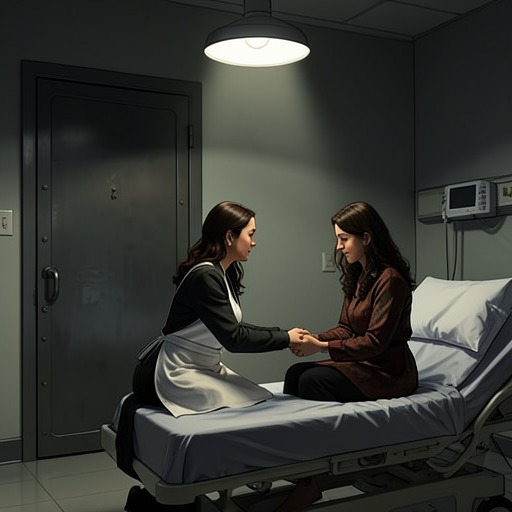
At the clinic, a counselor asked why she had not told her partner. West cried because the word did not fit the relationship, and because she still could not explain why she had kept the pregnancy from him. She remembers little of the rest of the appointment with certainty. She thinks there may have been a blood test and an ultrasound. The doctor told her the embryo was about three weeks old and gave her two pills, along with instructions to return in two weeks. The counseling, testing, medication, and follow-up made the process a course of medical care, while the question about her partner brought its emotional and relational context into the room.
The first pill did not remove West from ordinary public life. That evening she went with Mike to an arts awards event, where she presented a filmmaking prize to a friend and colleague. She later described the night as one of their best together. In private, she told a friend about the abortion; the friend reassured her about a frightening possibility described in the clinic’s pamphlet and hugged her. Mike cried when he learned that West had felt unable to tell him. The disclosure brought them closer for a time, but the relationship ended within six months. These details resist a simple account in which a procedure either creates a permanent rupture or resolves an existing one: the abortion took place inside a relationship that was already troubled, and the couple’s brief closeness did not last.
Information and the culture of silence
West’s criticism is not only that care can cost too much or require waiting. She also describes being unprepared for what the process might involve because abortion was not discussed openly. A pamphlet warned that the second medication could cause the body to pass material in large pieces, but the warning arrived as a startling instruction rather than part of a frank public conversation. West imagines how different it would be if people seeking abortions were not blindsided by such information in a photocopied handout. Her point is not that patients should be spared accurate medical information; it is that information should be communicated plainly, with care, instead of arriving against a backdrop of taboo.
That silence, she argues, gives opponents of abortion room to portray patients as callous or to insist that the procedure is invariably traumatic, painful, and agonizingly difficult. West rejects those universal claims without denying that other people may experience trauma or regret. Her own memory is mixed: the decision mattered, but the procedure itself was the easiest part of the experience. The greater harm, she says, would have been being unable to obtain it. This distinction places access at the center of her account: the relevant question is not whether every patient feels the same way, but whether people can decide for themselves and receive the care they seek.
Fatphobia and bodily autonomy
West also describes the abortion as entangled with internalized fatphobia and her fear of adulthood. She had connected pregnancy to her anxieties about being loved and about whether anyone could want a lasting relationship with her. In her account, the prospect of carrying the pregnancy became bound up with a punishing judgment of her own body and worth. She does not present that judgment as a reason that other people should assess her decision; rather, she identifies it as part of the emotional and cultural pressure surrounding her particular experience.
Her broader position is that there are no morally ranked categories of abortion that outsiders can use to decide whose choice is acceptable. What matters is whether a pregnant person wants to continue the pregnancy and whether they have access to care and support, rather than institutional barriers and misinformation. That position also explains why she insists on speaking about an experience she considers, in many respects, mundane. Abortion became socially charged not because her procedure was extraordinary, but because a culture invested in punishing women’s sexuality and tying them to motherhood taught her to approach it with shame and describe it in whispers. Telling the story contests that silence while preserving the complexity of what happened: a significant decision, an ordinary medical procedure, and a life made harder by obstacles that were not inevitable.